Today, CTV News reported on some comments made by Toronto councillor Giorgio Mammoliti about his ideas for tackling gun and gang crime in the north ward. Mr. Mammoliti has suggested that the problem should be solved by bringing in the army.
It’s not clear exactly what he has in mind. In the CTV article, he is quoted as saying "I'm not talking about tanks, I'm not talking about armed guards on corners, I'm not talking about any of that". So, overt displays of martial law seem to be off the table. Perhaps Mr. Mammoliti is just hoping for some special forces assistance from JTF-2, to supplement the existing paramilitary police structure.
CITY TV also reported on the story, adding this quote from Mammoliti:
"The army can come in here and deal with things this way they feel they need to be done and they got a whole new set of rules," the city councillor asserts. "And I know this community would want to see that happen. We know who the gang members are and it's time that we deal with them the same way we'd deal with anyone else that comes in with arms and takes over communities."
This sounds like an argument for the military pacification of problematic communities to me. The allusion to a ‘whole new set of rules’ and the depiction of the gun and game problem as an armed occupation suggests that Mr. Mammoliti is thinking about something altogether different from a criminal justice approach.
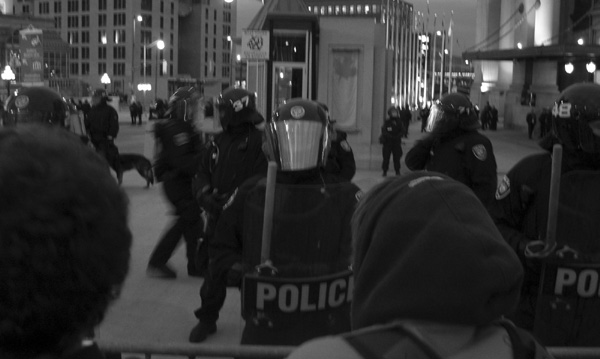
Many critical criminologists, sociologists and legal scholars have spoken out against our late modern preoccupation with the criminalization of social problems. I’m a particular fan of Richard Ericson’s comments on the issue in ‘Crime in an Insecure World’. One of the most problematic – and unfortunately, most popular - ways to criminalize a social problem is to locate it within a ‘war on’ framework. The current, paramilitarized state of policing owes much to the influence of the ‘war on drugs’, ‘war on crime’, and lately, the ‘war on terror’ (note that Mr. Mammoliti, according to the CTV article, seems to equate gang crime with terrorism). Without going into too much detail, it’s important to note that the ‘war on’ framework has never produced solutions to the problems it is applied to. The ‘war on drugs’ is perhaps the best example of this – prohibition is a proven failure: it fails to reduce use and addiction levels; leaves underlying public health concerns unaddressed; increases prison populations (and through this, the subsequent disintegration of families and communities); creates a lucrative black market in narcotics that guarantees the ongoing involvement of organized crime; and, thanks to an escalating and profitable arms race, it has led to the gradual paramilitarization of policing.
The so-called ‘war on terror’ offers additional examples of the inevitable results of declaring war on a noun – the underlying problem remains unresolved, but everyone winds up with more guns. In the contemporary context, and under the ‘war on terror’ rubric, we are seeing the continued blurring of boundaries between policing and soldiering, with detrimental consequences for the rule of law and fabric of democracy.
I mention this in order to put Mr. Mammoliti’s comments in context. His ward is dealing with a serious set of problems related to firearms and gangs (and poverty …), and I am sure that he is sincere in his expression of frustration, and in his search for alternative solutions. In his frustration, he is proposing a proto-fascist response that closes the policing-soldiering gap and re-frames the problem within a warfare / enemy logic (as opposed to a crime / criminal logic). This is the product of gazing at social problems through a ‘war on’ lens.
Mr. Mammoliti’s proposal will not result in ‘boots on the ground’ in the north ward. Such an action remains politically impossible (for now), not to mention a violation of some of the basic principles of liberal democracy. One cannot simply deploy the military for policing purposes, even within the new Canada Command framework. Realistically, we can anticipate some political claims-making both in favour and in opposition to the idea, probably resulting in calls for increased policing resources.
The Chief of the Toronto Police Service issued a response to Mr. Mammoliti's statements this afternoon, condemning them as an insult to the work of the police. I had hoped that the Chief would have made some additional remarks on the fundamental differences between the Toronto Police Service's mandate and that of the Canadian Forces. Oh well!
What is interesting about this case is the way Mr. Mammoliti’s comments offer us a glimpse at the sort of authoritarian (I would say ‘escalationist’) impulses that often lurk beneath mainstream discourses of social control. What fundamental ideas about the nature of social problems, law, policing, and justice underlie a “send in the army” argument? What can we say about a society where the essential differences between policing and soldiering seem inconsequential?