Showing posts with label Policing. Show all posts

Friday, March 21, 2008

Remember the Arar Commission?

There was much discussion and fanfare yesterday, as the government announced the creation of a new council to oversee the restructuring of the RCMP. 

The RCMP Reform Implementation Council has been created to follow up on and implement the recommendations made by the Task Force on Governance and Cultural Change in the RCMP. Some months back, I did a three-part blog on RCMP reform, comparing the Task Force report to the recommendations made by the Arar Commission of Inquiry. You can see part 1 of the series here, part 2 here, and part 3 (the comparative analysis and discussion) here. In particular, I compared the two models of oversight put forward by the two reports. In my conclusion, I noted that the model put forward by the Task Force fails to address the problems that RCMP national security activities (and other forms of collaborative or integrated policing) pose for governance and oversight. In short, the Task Force report seems to have ignored the lessons learned from the Arar Inquiry (or rather, conveniently ignores that the whole Arar Affair took place at all). 

We are now at the implementation stage, and it is clear that the government has opted to follow the Task Force report as a guideline for the restructuring of the RCMP (see, for example, the Council's terms of reference). You can look at the bios of the Council members (as provided by Public Safety Canada) here. The RCMP has announced that it welcomes the creation of the new Council, and that an internal Change Management Team has been established to work with the Council on restructuring.

I am not entirely critical of the Task Force report, and some of the recommended changes which will be implemented in the coming months have merit. But, the report is a management document, written by managers and bureaucrats, and its goal is to improve the "organizational excellence" of the RCMP as a corporation. The O'Connor Report, following from the Arar Inquiry, is based on a different set of objectives, and it follows from one of the most serious and consequential episodes in the history of the force. If RCMP reform is not to take place along the lines recommended by O'Connor, at the very least his remarks about the review of RCMP national security activities must be taken into consideration.

Major structural changes to the RCMP do not occur often, and it is unlikely that we will see another window of opportunity for the substantive enhancement of the organization's accountability, review, and oversight mechanisms in the near future. So, if the recommendations of the O'Connor Commission on this matter are to have any teeth at all, the time for them to be taken up is now. The very idea that, less than two years after the filing of the final report in the Arar Inquiry, RCMP reform could go forward with no formal reference to the Arar Affair is troubling, to say the least.  That such a reform plan could be announced without the media asking any questions related to Arar or the Commission is baffling. Sure enough, though, the CBC, The Globe and Mail, and CTV all allowed their reporting on the story to be framed by the government's own remarks (which omit any mention of Arar). The critical commentary that I have seen from the Canadian media deals with whether and to what extent the new Council will follow all of the recommendations of the Task Force, and about the composition of the Council itself. 

The Task Force report, Rebuilding the Trust, makes only one mention of the Arar Affair. On page vii, in the introduction, the report notes that

"At the time of our appointment and throughout the term of our mandate, the RCMP was under intense public scrutiny. In addition to the Investigative Report, Justice O'Connor had recently released his report on the Arar affair and made very significant recommendations."

That's it. 

My concern is that, for political reasons, specific references to the O'Connor Report, and through it, to the Arar Affair, will be conspicuously absent from the publications of the RCMP Reform Implementation Council, its internal RCMP counterpart, and other parties involved in this restructuring effort. And, consequently, it will be very difficult for us as citizens to evaluate the end product of the process in light of the concerns raised by Commissioner O'Connor. 

I will be following the progress of the Council, and writing about the RCMP restructuring process as it unfolds.

All the best,

- Mike

Monday, January 14, 2008

Regarding the Server in the Sky Project

(Jan 19 - Updates added at bottom of article)

Yesterday’s edition of The Guardian included an article entitled "FBI wants instant access to British identity data", by Owen Bowcott. The article outlines a US-initiated program called "Server in the Sky", whose objective is the development of a massive international database - which would include biometric data - for use in major crime and terrorism investigations. Bowcott reports that the program has been the subject of an international working group, including the US, the UK, Australia, Canada, and New Zealand. This working group is called the International Information Consortium.

The project involves the linking of existing databases, and the facilitation of transnational flows of data. The Server in the Sky program is an FBI initiative, "designed to foster the advanced search an exchange of biometric information on a global scale". The system is not active yet, but a pilot project is expected to be up and running by the middle of 2008.

Server in the Sky is the most recent example of the increasingly-interconnected nature of contemporary policing, and from what little information is available, it appears that the project will streamline and expand upon already-existing data-sharing arrangements. Projects of this nature raise many important questions regarding privacy, the integrity of databases, and the ownership of personal data. Server in the Sky will act as a searchable international archive of biometric data. Times Online reports that the system will "establish three categories of suspects on the system: internationally recognised terrorists and felons; major felons and suspected terrorists; and those who are the subject of terrorist investigations or criminals with international links".

For it to be useful (and this is 'educated conjecture' on my part), it will have to be able interface with existing biometric databases, cross-checking data from crime scenes or police archives with other sources of biometric information in the hopes of finding a match. I suspect that a fully-operational Server in the Sky program would allow an FBI agent in New York to input a selection of fingerprints or DNA sample, and search for matches in a variety of foreign police databases - and probably immigration and refugee databases - and quite possibly medical databases. As more and more states move towards identity documentation systems that include biometric markers, and as more services require that users give up biometric data, the pool of possible suspects for programs like Server in the Sky increases. And we should be clear on this point - integrated surveillant assemblages that utilize biometric data-matching operate by treating all 'data doubles' (human traces translated into data - a term introduced by Haggerty and Ericson, 2000) as potentially suspicious. 

I will be following this program as it develops, and posting updates and commentary. For now, here are a few predictions. Once things have solidified, we'll see if I'm right.

Prediction 1: Regardless of who the lead agency on Server in the Sky turns out to be (and it looks to be the FBI at this point), the program itself will be developed by a private contractor. This will likely be Northrop Grumman, the company that built the UK IDENT1 database.

Prediction 2: The program will link policing databases with other sources of biometric data. If this is not a feature of the initial pilot project, it will be phased in over the next few years. Immigration and border services databases will likely be the first to link up. Britain is currently implementing a national identity card system (initially for foreign nationals, but expect it to be a population-wide requirement within the next few years), and I would be shocked if the Home Office didn't take steps to integrate this rich pool of data with the new Server in the Sky program.

Prediction 3: The program mandate will gradually creep, moving from the planned database covering the 'worst of the worst' to a general policing and security focus. This could happen through an expansion of Server in the Sky, but it is more likely that the success of this program will lead to the development of similar projects. Which will, of course, be integrated with the existing system.

All for now,

- Mike

Update (Jan 15): Today's Guardian Comment is Free section includes an article by Nick Clegg, the British Liberal Democrats' home affairs spokesman, entitled "Let's not spy for the FBI". Clegg raises concerns about the privacy implications of giant international biometric databases, and he briefly touches on the problems associated with the safeguarding of data. 

Update (Jan 19): A few additional articles on the Server in the Sky program.
  • Today's Globe and Mail offers a Canadian perspective, including some comments from Privacy Commissioner Stoddart (who first learned about the program from a media report from London, presumably the Guardian article discussed above). Stoddart expresses concern about the haste with which biometric security projects are moving forward. Also included in the Globe article is a reference to a statement from the RCMP, confirming their involvement in talks with the FBI, but denying that commitments have already been made.
  • The Jan 20 Sydney Morning Herald includes an article entitled 'Space race for world's most wanted', which covers the story from an Australian perspective. As with the Globe and Mail article, the Herald sought a comment from authorities, and received a confirmation of talks but a denial of firm commitment. The article also mentions that Australia is close to completing a national DNA database. 
  • A January 19 Comment is Free article at The Guardian, by Simon Ings, is entitled 'The soul stealers: Our beautiful, unique irises are to be relegated to the dystopian realm of state security'. 
  • The Guardian also published an excellent article by Cory Doctorow on Jan 15, entitled 'Personal data is as hot as nuclear waste'. The article uses the nuclear waste metaphor to highlight the potential harm associated with vast databases of personal information, as well as the comparable longevity of the data. I am particularly fond of this passage: "Every gram - sorry, byte - of personal information these feckless data-packrats collect on us should be as carefully accounted for as our weapons-grade radioisotopes, because once the seals have cracked, there is no going back. Once the local sandwich shop's CCTV has been violated, once the HMRC has dumped another 25 million records, once London Underground has hiccoughup up a month's worth of travelcard data, there will be no containing it."
  • The 'computing market intelligence' website Vunet.com published a brief synopsis article on Jan 15, largely based on the initial Guardian report. The Vunet.com article does make the important additional observation that the five countries involved in the International Information Consortium (and through it, Server in the Sky) - the UK, US, Canada, Australia, and New Zealand - are all involved in the Echelon global eavesdropping program.
  • The British website The Register posted a detailed Jan 17 article entitled 'UK.gov says no plans for FBI DNA database hookup'. The Register contacted the National Policing Improvement Agency (NPIA) for comment on the Server in the Sky program, and was informed that there are currently no plans to integrate the existing databases into an international system. Currently. The article also includes this description of the Server in the Sky program: "The idea of "Server in the Sky" is that the traditional intelligence/security axis run by the Anglophone nations of the former British empire - the US, UK, Canada, Australia and New Zealand - would be extended into regular law enforcement. Most significantly perhaps, the cooperation might go as far as the interlinking of national biometrics databases. An FBI agent on a case might be able to check DNA from a crime scene and get a hit from the UK database, for instance. Or a British plod might likewise get one from the States, though America holds much less data." The Rgister article also gives a more specific account of the members of the International Information Consortium - rather than citing the nations involved, it lists the member agencies: FBI, RCMP, NPIA (UK), CRIMTRAC (Aus) and NZ Policing.

Tuesday, January 8, 2008

Making Sense of Two Proposals for RCMP Review - Part 3

Links to

Part 1, on the Task Force on Governance and Cultural Change in the RCMP report on Rebuilding the Trust, and;

Part 2, on the O’Connor Commission Report on a New Review Mechanism for RCMP National Security Activities.

Part 3: ICCOR, ICRA, and Beyond

Two reports on RCMP review have recently been given to the Government, and there will almost certainly be some RCMP restructuring during 2008 in response. In previous posts, I have summarized the key recommendations of each report as they pertain to RCMP review. Several questions arise from reading these documents:

  1. Are the two reports comparable in terms of objectives and scope?
  2. How would following either of the reports change the way that the RCMP is structured, or the way that it functions?
  3. What are the major similarities and differences between the reports?

Objectives and Scope:

For starters, it is important to consider the different goals of the Task Force on Governance and Cultural Change in the RCMP and the O’Connor Commission.

O’Connor’s report arises from the mandate of the Commission of Inquiry into the Actions of Canadian Officials in Relation to Maher Arar. It is ‘part 2’ of the Commission deliverables, with the first part being an in-depth Factual Inquiry. The Commission was set up to assess the ways in which the treatment of Maher Arar may have reflected deeper problems with the RCMP’s national security activities (I won’t go into detail about the limitations of the Commission mandate here – a future blog topic, no doubt). The overall objective of the O’Connor Report is the outlining of a new RCMP review mechanism that could provide accountability for RCMP national security activities, given the problems revealed by the Commission. At first glance, we might conclude that this objective makes for a rather narrow mandate; most RCMP activities are unrelated to national security investigations, after all. The O’Connor report (by virtue of the Commission mandate) does not provide direction as regards the review of other federal policing activities, contract policing at the provincial level, protective policing, or aspects of transnational policing outside to the national security realm. On the other hand, O’Connor adopts a very broad understanding of the policing of national security, and he recognizes the RCMP as one actor in an increasingly complex and interwoven field. Consequently, while his report is focused on the RCMP as an entity, his recommendations often address activities that take place on the borders of that entity, where it intersects with foreign and domestic partners.

The Task Force report emerges from a much different mandate. The Task Force was set up to examine governance and cultural change in the RCMP following a scandal over RCMP pension and insurance plans (and an independent report on the matter, written by the head of the Task Force). The terms of reference for the Task Force direct it to consider a broad range of issues, including RCMP management structure, accountability and transparency, employee relations and grievances, and ethics. Given this broad mandate, the Task Force was free to make recommendations on matters outside the scope of the O’Connor Commission. The Task Force Report considers and makes major recommendations on the relationship between the RCMP and the Government, the governance and management of the RCMP, and RCMP review and oversight. While the scope is much wider than that of the O’Connor Commission, the Task Force report is considerably shorter, and it lacks the attention to detail and depth of O’Connor’s recommendations regarding review.

Ultimately, the O’Connor Report sets out focused recommendations regarding a particular facet of RCMP review, whereas the Task Force Report sets out very broad recommendations about the RCMP and its activities, one of which deals with review and oversight.

Structural Matters:

The Task Force Report recommends the creation of an Independent Commission for Complaints and Oversight for the RCMP (hereafter the “ICCOR model”), while the O’Connor Report recommends the creation of an Independent Complaints and National Security Review Agency for the RCMP (hereafter the “ICRA model”).

The ICCOR model would see the creation of a five-member arms-length review and oversight body that would absorb the existing CPC and ERC bodies, effectively consolidating all RCMP review and complaints (both external and employee) functions under one roof. ICCOR would have a comprehensive mandate that encompasses all aspects of RCMP operations. It is important to note that the creation of ICCOR would correspond with other major alterations to the RCMP’s structure and operations. The Task Force recommends that the RCMP be given ‘separate employer’ status (creating greater independence from government), and that a Civilian Board of Management “with strong business expertise” should be created to oversee “finances, staff, property, services, resources and procurement” (the Commissioner would remain in charge of policing). ICCOR recommendations arising from reviews would go to both the Commissioner and the new Board of Management.

By contrast, the ICRA model proposed by Commissioner O’Connor would see a new national security review mechanism created within the existing CPC, which would then be renamed ICRA. ICRA would be responsible for all complaints pertaining to the RCMP, and for self-initiated or directed reviews of RCMP national security activities. Its mandate would not encompass employee grievances and disciplinary matters, which would presumably remain with the existing ERC body. Additionally, O’Connor envisions ICRA reporting to the Commissioner of the RCMP, and operating in relation to an otherwise-unchanged RCMP structure. If O’Connor’s recommendations were followed to the letter, ICRA would also be responsible for the review of the national security activities of the Canada Border Services Agency (CBSA), something not addressed by ICCOR. Additionally, the O’Connor Report recommends the creation of an Integrated

National Security Review Coordinating Committee (INSRCC), which would coordinate national security-related reviews undertaken by ICRA, the Security Intelligence Review Committee (SIRC), and the Commissioner of the Communications Security Establishment (CSE). The ICCOR model makes no recommendations for a similar meta-review body (or super-nodal review structure).

Major Similarities and Differences:

In some respects, the two models are quite similar. Both models would create an independent and arms-length body with enhanced powers. Both would incorporate the existing Public Complaints Commission (CPC) into the new model. Both envision a review body capable of responding to complaints, initiating its own investigations, or undertaking investigations at the behest of the Minister of Public Safety. Both models propose that the new review body should make non-binding reports that are made public (to the extent possible) – although ICCOR would see these reports being given to the RCMP Commissioner and new Board of Management, whereas ICRA would see the reports given to RCMP Commissioner and the Minister of Public Safety.

Important differences exist between the models as well. First, it is important to note that ICCOR incorporates both review and oversight (nominally, at least – it is sparse on details and does not discuss the differences between the two), whereas ICRA specifically focuses on review. For a good discussion of why this emphasis is important, I recommend listening to Ron Atkey’s remarks during the last Nathanson Centre “After Arar” workshop. The reason for the different approaches to the review / oversight question has to do with the ways that the authors of the two reports envision the relationship between the RCMP (and police more generally) and government, and with their opinions on the degree of involvement that the new body should have in the ongoing activities of the RCMP. Generally speaking, review mechanisms address complaints and undertake investigations with the goal of ensuring a match between operations and existing accountability structures (guidelines, rules and regulations, laws, etc). Oversight bodies, O’Connor notes, are understood to be part of the accountability structure of an organization, which gives them broader mandates for directing activities. O’Connor does not include oversight in his outline for ICRA, and he justifies this by arguing that

“An oversight mechanism could confuse, or even lessen, both the RCMP’s accountability to government and government’s responsibility for the RCMP. A body that engages in oversight might also lose some of its independence from the RCMP and become implicated in decisions that should be subject to independent review after the fact. Most importantly, I base my conclusion on the fact that an oversight mechanism would not respect the doctrine of police independence” (pp. 457-458).

The Task Force Report does not address these concerns as regards oversight. A major aspect of the Report is its recommendations around separating the RCMP from government (through independent employer status and the creation of a Board of Management). The Report does note that this is intended to strengthen RCMP accountability to government, and not to provide an insulating layer. I would like to see the Task Force provide greater detail on this matter.

Two other important differences stand out.

First, the ICCOR model as presented does not reflect any sensitivity to the challenges presented by RCMP national security activities over and above ‘regular’ policing. In fact, one could be forgiven for thinking that the Task Force Report was written prior to the Arar Affair, and indeed prior to the changes that followed in the wake of September 11, 2001. Even the most conservative reading of the reports of the O’Connor Commission would have to acknowledge that there are unique problems associated with the governance of accountability in relation to the policing of national security.

The ICRA model certainly recognizes this. It notes the particular inadequacies of a complaints-based approach to accountability in relation to national security activities (which are generally so secret that by the time someone is in the position to launch a complaint, the damage has already been done – Arar is a good example). Accordingly, O’Connor spends a good deal of time emphasizing the importance of self-initiated reviews.

Beyond this – and this is, in my opinion, the most significant difference between the two models – the ICRA model deals with the RCMP as one node in a network of national security policing, whereas the ICCOR model reflects an archaic and myopic understanding of the RCMP as an island unto itself (at least as far as review is concerned).

Conclusions:

The short version: The ICCOR model fails to recognize that the RCMP exists in a network, and the ICRA model is limited by its focus on national security.

Either model would probably produce enhanced accountability, but ICRA strikes me as being more forward-looking, reflecting a better understanding of the nature of modern policing. The fact is that contemporary policing activities, both national security-related and otherwise, are increasingly networked and collaborative in nature. The policing of transnational crime requires international cooperation, as does the policing of national security. The RCMP is an important node in Canada’s network of national security agencies, and it should have its own arms-length review body to ensure accountability. But, to the extent that the RCMP does not operate in a vacuum, neither should its review body be bound by a top-down, inward-looking mandate. The ICRA model is not a perfect alternative, but it does incorporate a number of important principles: it recognizes the networked nature of national security policing and allows that ICRA review may have to go beyond the RCMP (when circumstances dictate, and with the permission of the Minister of Public Safety); it acknowledges the existence of comparable review mechanisms, and specifically mandates cooperation between these bodies and ICRA, in the form of ‘statutory gateways’, joint review activities, and, most importantly, the coordinating super-agency structure provided by the Integrated National Security Review Coordinating Committee; and it recognizes that the overall level of accountability will suffer so long as some participating departments and agencies do not have their own review mechanisms. In short, ICRA better addresses problems associated with policing and national security, while ICCOR focuses its attention on the conduct and management of the police.

I think that the limitations of the ICCOR model were in some ways inevitable, given the emphasis that the Task Force placed on the “business” of the RCMP (this emphasis was itself a product of the composition of the Task Force). The goals, language, and mentality of corporate governance, fiscal responsibility, and management seem suited to the fostering of a ‘business model’ that is efficient, independent, and structurally sound, but not to the production of substantive accountability in a networked field.

Moving forward, it is possible to envision a model that retains some of the best aspects of both ICCOR and ICRA, while compensating for their respective limitations. Such a model would look like ICRA, but with the additional grievance and disciplinary mandate of ERC incorporated. It would be arms-length, independent, and with enhanced investigatory and review powers (as recommended by both reports). These powers and the mandate of the new review body would be set out in legislation. The new body would incorporate a special mandate for the review of RCMP national security activities, above and beyond the complaints process, and this mandate would emphasize the importance of self-initiated, directed, and / or third-party-initiated review. As per ICRA, the new review body would also be responsible for the review of the Canada Border Services Agency (CBSA). Ideally, the recognition of the networked nature of policing (not just national security-related, but policing in general) would be enshrined in the legislation and mandate of the review body. This would include the goal of creating and maintaining 'statutory gateways', as per ICRA, again not limited to the national security field. Further, the national security review activities of the new RCMP review body would be coordinated by an Integrated National Security Review Coordinating Committee, which would also coordinate review activities for SIRC and the CSE Commissioner. 

Such a review body would be able to operate within the new RCMP structure set out in the Task Force Report, provided that the Civilian Board of Management was appropriately staffed and reasonably stable. 

There are many additional problems of governance and areas where police reform is necessary, but I have limited these remarks to the areas covered by the two reports in question. In the coming months, the question of RCMP reform - including a new review body - will be taken up in earnest by the Government. New legislation will be required, so the matter will definitely come before Parliament as well. At present, both the ICCOR and ICRA models are on the table. Neither are adequate on their own, but a combination of the two would be a good start for reform. I would argue that adopting a model based on ICCOR and the Task Force Report, without the additional considerations provided by O'Connor, would be disastrous, and I hope that the government's apparent enthusiasm for the Task Force report is not a sign that such an approach is being considered.

- Mike

Making Sense of Two Proposals for RCMP Review - Part 2

Link to Part 1.

Part 2: The O’Connor Report on A New Review Mechanism for the RCMP’s National Security Activities

The Task Force report discussed in part 1 made recommendations that encompassed both review and oversight. Commissioner O’Connor differentiates between the two:

To summarize, a review body assesses the activities of an organization against standards such as lawfulness and propriety and delivers reports, which often contain recommendations, to those in government who are politically responsible for the organization. In contrast, an oversight body performs the same functions but plays a more direct role in the management of the organization.

He suggests that RCMP national security activities require a new review mechanism, but not an oversight body. His rationale is that such a body could intrude on the principle of police independence, potentially diminish the accountability of the RCMP to the government, and potentially compromise itself by getting too close to a sensitive investigation. Ultimately, O’Connor argues that a review body without oversight responsibilities would be able to exercise maximum critical distance and independence.

Several specific aspects of the RCMPs national security activities are flagged by O’Connor as necessitating an enhanced review mechanism, which I summarize below:

1. Lack of Transparency: The secrecy associated with national security investigations coupled with the preemptive / preventative nature of such activities in the contemporary context means that a complaints process such as the CPC cannot be counted on to ensure accountability. Individual rights and procedural rules may be violated in ways that are not immediately apparent. Accordingly, O’Connor recommends that the new RCMP review body be able to self-initiate reviews in a manner similar to CSIS’ review body, SIRC.

2. Increased Information Sharing: The Arar Affair made it abundantly clear that the forms of inter-agency information sharing that characterize national security investigations exceed the capacity of agency-specific review bodies. O’Connor recommends that the new RCMP review body pay particular attention to the policing of RCMP info-sharing practices .

3. Increased International Cooperation: As with the above point, but in relation to transnational information-sharing. The O’Connor Commission found that the RCMP’s existing policies were sorely lacking in this regard, particularly as regards the human rights implications that might arise from the transmission or receipt of information (as illustrated by the Arar case and similar instances). O’Connor argues that a new RCMP review body should be able to ensure that decisions around this sort of info-sharing are subject to accountability and independent review.

4. Potential for Racial, Ethnic, and Religious Profiling: O’Connor recognizes that contemporary national security investigations create a heightened risk of profiling, and that an enhanced review body is necessary to ensure accountability on this matter. The subtext is that systematic racial profiling cannot be addressed through individual complaints.

5. Lack of Judicial Scrutiny: The quantity and scope of national security investigations greatly exceeds the number of cases that proceed to prosecution - the stage where judicial scrutiny can provide accountability for police actions. Further, the secrecy associated with these activities means that even when judicial pre-authorization is sought for particular investigative techniques, it is necessarily done ex parte, without adversarial contestation. O’Connor concludes that the comparative lack of judicial scrutiny must be compensated for by an enhanced review capacity.

Based on these observations, and given the overarching objective of ensuring that the RCMP is held accountable for its national security activities, O’Connor makes the following recommendations (again, summarized. See the O’Connor Report, starting at p. 603 for an official summary of recommendations):

1. An Independent, Arms-length review and complaints mechanism with enhanced powers should be created.

2. This new body should be located within a restructured CPC, and the amalgamated body should be renamed the Independent Complaints and National Security Review Agency (ICRA).

3. ICRA’s mandate should allow it to conduct self-initiated reviews of RCMP national security activities. ICRA should also be able to undertake investigations and report on complaints made by individuals and third parties. ICRA’s mandate should also allow it to conduct joint reviews or investigations with SIRC and the CSE Commissioner into integrated national security operations involving the RCMP. Additionally, ICRA should be able to initiate investigations or reviews at the request of the Minister of Public Safety. Beyond this, at the request of the Governor in Council, ICRA should be have the authority to conduct reviews or investigations into national security activities of other government departments or employees. ICRA would be mandated to make recommendations to the Minister of Public Safety and, in the case of investigations outside of the Public Safety portfolio, to other relevant ministers.

4. ICRA should have extensive investigative powers, similar to those of public inquiries under the Inquiries Act. This should include the power to subpoena documents and compel testimony. ICRA should also have the power to stay a review so as not to interfere with an ongoing criminal investigation or prosecution. ICRA should have the power to conduct public education programs and provide information concerning its role and activities, and to commission research on relevant matters.

5. ICRA should be able to refer complaints to the RCMP for investigation or to investigate them itself, and to review complaints investigated by the RCMP. ICRA should be able to dismiss a complaint at any complaint at any stage (on the basis that it is trivial, frivolous, vexatious, or made in bad faith). ICRA should also be able to undertake mediation and informal complaint resolution. ICRA should be able to hear representations from members of the RCMP and the complainant, and / or counsel for either. ICRA should be able to conduct hearings pursuant to a complaint in private when ongoing investigations, confidentiality, or national security concerns are at issue. ICRA should be able to appoint security-cleared counsel independent of the RCMP or government to test official claims around confidentiality or disclosure of information. ICRA should be able to seek the opinions or comments of other accountability bodies.

6. ICRA should be structured so that complaints and review related to RCMP national security activities are addressed only by specified members (with the goal of inspiring public confidence in the process - O’Connor recommends an appointment process similar to SIRC).

7. ICRA should prepare reports for the Minister of Public Safety and the Commissioner of the RCMP on an annual basis (an edited version should be given to Parliament), and following individual complaints or reviews - the latter should include non-binding findings and recommendations.

8. ICRA should have an adequate budget to fulfill its mandate.

9. Quoting directly: “There should be independent review, including complaint investigation and self-initiated review, for the national security activities of the Canada Border Services Agency, Citizenship and Immigration Canada, Transport Canada, the Financial Transactions and Reports Analysis Centre of Canada and Foreign Affairs and International Trade Canada.” This is a hugely important recommendation. O’Connor recognizes the lack of oversight associated with some of the organizations that RCMP interacts with in national security investigations. In order for an integrated national security structure to be accountable, its individual components must include their own review mechanisms. Even if an ideal RCMP national security review body were realized, it would be unable to ensure maximum accountability in an collaborative environment where the RCMP’s partners are not subject to similar accountability mechanisms.

10. O’Connor recommends that CBSA be brought under the ICRA review mandate, and that the other agencies mentioned in point 9 be moved under SIRC’s mandate.

11. ‘Statutory gateways’ should be created to allow for information-sharing and cooperation between ICRA and other Canadian national security review bodies.

12. Again, quoting directly: “The government should establish a committee, to be known as the Integrated National Security Review Coordinating Committee, comprising the chairs of ICRA and the Security Intelligence Review Committee, the Communications Security Establishment Commissioner and an outside person to act as Committee chair.

INSRCC would have the following mandate:

• to ensure that the statutory gateways among the independent review bodies operate effectively;

• to take steps to avoid duplicative reviews;

• to provide a centralized intake mechanism for complaints regarding the national security activities of federal entities;

• to report on accountability issues relating to practices and trends in the area of national security in Canada, including the effects of those practices and trends on human rights and freedoms;

• to conduct public information programs with respect to its mandate, especially the complaint intake aspect; and

• to initiate discussion for co-operative review with independent review bodies for provincial and municipal police forces involved in national security activities.”

13. In five years, the government should appoint an independent person to investigate the framework for ICCRA set out by O’Connor’s report.

Between this post and the previous post on ICCOR, I hope to have provided a sufficient summary of both proposed review mechanisms to provide a basis for comparison and analysis in the third and final post in this series, which will be up tomorrow.

- Mike

Making Sense of Two Proposals for RCMP Review - Part 1

Briefly, this is the first of three blogs about RCMP oversight. The second and third parts of this series will be posted on Wednesday and Thursday.

Introduction:

On December 14 2007, the Task Force on Governance and Cultural Change in the RCMP released its report, entitled Rebuilding the Trust. The task force was led by David Brown, Q.C., a Toronto lawyer. In a previous but related role, Brown was the Independent Investigator who conducted a review into the RCMP pension and insurance plan scandal. This is important to note, as much of Rebuilding the Trust is framed as a response to the issues and themes that arose from that investigation.

All major Canadian media outlets covered the release of the report, including the CBC, the Globe and Mail, and the Toronto Star.

The Star provides a good overview of some of the main recommendations of the report:

Status: The RCMP should be granted "separate employer" status by Dec. 31, 2009, giving it greater freedom over staffing, finances and contracting. Right now the RCMP operates as a federal agency, subject to cumbersome government oversight and policies that are not appropriate for a police force. In turn, however, the RCMP must speedily upgrade its ability to manage staff and finances.

Oversight: A new civilian Board of Management with strong business expertise should be created in the same time frame, reporting to Parliament through the public safety minister. While the RCMP commissioner would be in charge of policing, the board would oversee finances, staff, property, services, resources and procurement.

Complaints: A stronger, Independent Commission for Complaints and Oversight should be created to deal with whistleblowers, probe wrongdoing and handle grievances.

I have provided a brief synopsis for Justin Piché’s Tracking the Politics of Crime and Punishment in Canada blog, which you can read here.

The report has received widespread support, not least from the Commissioner of the RCMP. We can anticipate that most of the recommendations will be implemented, though the timeline for such action is not presently clear. Expect broad cross-party support for the major recommendations.

It is important to note the general tone of the report. It is characterized by a categorically sympathetic attitude towards RCMP officers on the 'front lines'. Problems are noted, but they are attributed to management deficiencies, organizational structure (particularly bureaucracy), and lack of resources. There is absolutely no commentary on possible institutional-cultural bases for problems with the RCMP. This tone is not surprising, given the mandate and methodology of the Task Force, which focuses on the business of federal policing, rather than the business of federal policing. The report deals with management issues, with an emphasis on efficiency. It is about employee-employer relations, financing, and instituting a new board of directors. And yet, its recommendations touch on the accountability and oversight structure of the RCMP, with potentially huge implications.

Today, I want to focus on a specific aspect of the report – the recommendations regarding an Independent Commission for Complaints and Oversight of the RCMP (ICCOR).

This is of particular importance because it is the second recommendation regarding RCMP oversight that we have seen recently, the first coming from Commissioner O’Connor, in the form of his detailed A New Review Mechanism for the RCMP’s National Security Activities report. This report was ‘part 2’ of O’Connor’s report following the Commission of Inquiry into the Actions of Canadian Officials in Relation to Maher Arar (hereafter the O’Connor Commission). Commissioner O’Connor’s report is a 636 page tome, complete with a discussion of review models found in other countries, and an in-depth exploration of the various challenges posed by national security operations from a review and accountability perspective. The Task Force report, by contrast, is 79 pages in length. Bigger is certainly not always better, but the O’Connor Commission report is an important document, and any reasonable efforts to change the RCMP review and oversight structures in the near future will have to engage with it.

Plus, the O’Connor Commission cost the people of Canada a tremendous amount of money. I believe that it was money well spent, but only to the extent that we have the wherewithal and fortitude to understand it as a starting point rather than a conclusion to a scandal, and to take its recommendations seriously as we move forward with police reform.

Note that the Task Force received its mandate on July 16, 2007. The Review Mechanism report of the O’Connor Commission was available in December 2006. It is striking that the mandate given to the Task Force instructs it to consider matters of governance, accountability, and transparency – but makes no reference to the O’Connor Commission, which had just engaged with these issues.

On to the contents:

Part 1: The Task Force Report

The Task Force believes the creation of an Independent Commission for Complaints and Oversight for the RCMP (ICCOR) is necessary. This new body would incorporate both the CPC [Commission for Public Complaints Against the RCMP] and ERC [External Review Committee - the body that currently handles employee grievances] but provide expanded responsibilities and authorities. It would have the ability to review on its own initiative or at the request of the Minister, the Commissioner or the Board of Management any incident or aspect of the operations of the RCMP. The ICCOR would be the central and single collection and processing point for all complaints against any member of the RCMP, whatever the origin. The consolidation of all at the ICCOR will serve a broader purpose than simply co-ordinating the processing and oversight of complaints. It will allow for the tracking and evaluation of complaints, discipline and grievances in order to identify systemic issues, trends or deficiencies in policies and procedures; once identified, they may be addressed and improved through focused training programs, increased awareness or new policies or procedures. The findings of ICCOR relating to discipline or grievance situations would be binding on the Commissioner. Recommendations relating to policy or police operations would be made public but be for consideration only by the Commissioner or the Board of Management.

The proposed review body would have as its goal the enhancement of public confidence in the RCMP and bring under one independent civilian umbrella:

• a complaints process including an investigations unit with access to experienced investigators with special investigative capacity plus a dispute mediation unit

• a complaint evaluation and data collection unit that would also monitor progress and timelines respecting complaints and publish appropriate reports

• a separate external review function for grievance and discipline appeals, whether or not they arise out of a complaint against the member

• a mandate to review any aspect of policing operations including operational reviews and make recommendations to the Commissioner and the Board of Management

So, to boil it down, ICCOR would consolidate public complaint, policy and operational review, and employee grievance functions under a single roof, under an “independent civilian umbrella”. It would be able to respond to complaints and grievances, and to initiate its own investigations. This sounds reasonable, and it seems like an improvement over the current system.

If adopted as proposed, ICCOR would represent a major new direction for the RCMP. My concern is that the report that outlines this new Complaints and Oversight body recommends that it be mandated with broad review powers, without mentioning how this review and oversight function would handle (1) the specific challenges posed by national security issues or (2) integrated and inter-agency activities. The Task Force report does not recommend any substantive alterations to the RCMP review process beyond ICCOR.

In Part 2, I will review the recommendations of the O'Connor Commission relating to a new review body for RCMP national security activities. Part 3 will present a comparative analysis and discuss similarities and discrepancies between the reports.

- Mike


Friday, December 7, 2007

Follow-Up to ‘Apprehended Insurrection in the North Ward?’

The media and several elected officials (including the Mayor) have had the opportunity to respond to Councillor Giorgio Mammoliti’s call to bring in the military to deal with gang crime in his Toronto ward, which I talked about yesterday.

Today’s reports include additional comments from Mr. Mammoliit as well. I thought that it would be worth compiling his statements, just in case I need some discourse samples for a study of proto-fascism down the road.

From CTV.ca:

"I'm not talking about tanks, I'm not talking about armed guards on corners, I'm not talking about any of that,"

"I'm talking about bringing the resources and the tools that the army has at their fingertips to be able to resolve the problem immediately, so the army is a good way to do that."

From the Toronto Star:

"Gang members will retaliate and hurt people who talk," […] "The gangs are at war in our wards, and innocent people are being caught in the crossfire. If the feds can justify that (designation), perhaps there could be some law that could take them off the streets."

From the National Post:

"If we can call in the army to remove snow as a crisis, we need to be dealing with other crises that exist in the city," […] "This, in my opinion, is a crisis and we should be asking for some help."

"I want [the federal government and the military] to consider these individuals as terrorists, because that's what they are. Why does a terrorist have to be someone who doesn't live in this country? Why does it have to be someone who's planning to plant a bomb somewhere?"

"This community, they would like to see these gang members taken off the streets and held indefinitely, if possible," […] "The only people that have that authority are the federal government and the army, quite frankly."

From City TV:

“We know who the gang members are and it's time that we deal with them the same way we'd deal with anyone else that comes in with arms and takes over communities."

Thursday, December 6, 2007

An ‘Apprehended Insurrection’ in the North Ward?

Today, CTV News reported on some comments made by Toronto councillor Giorgio Mammoliti about his ideas for tackling gun and gang crime in the north ward. Mr. Mammoliti has suggested that the problem should be solved by bringing in the army.

It’s not clear exactly what he has in mind. In the CTV article, he is quoted as saying "I'm not talking about tanks, I'm not talking about armed guards on corners, I'm not talking about any of that". So, overt displays of martial law seem to be off the table. Perhaps Mr. Mammoliti is just hoping for some special forces assistance from JTF-2, to supplement the existing paramilitary police structure.

CITY TV also reported on the story, adding this quote from Mammoliti:

"The army can come in here and deal with things this way they feel they need to be done and they got a whole new set of rules," the city councillor asserts. "And I know this community would want to see that happen. We know who the gang members are and it's time that we deal with them the same way we'd deal with anyone else that comes in with arms and takes over communities."

This sounds like an argument for the military pacification of problematic communities to me. The allusion to a ‘whole new set of rules’ and the depiction of the gun and game problem as an armed occupation suggests that Mr. Mammoliti is thinking about something altogether different from a criminal justice approach.

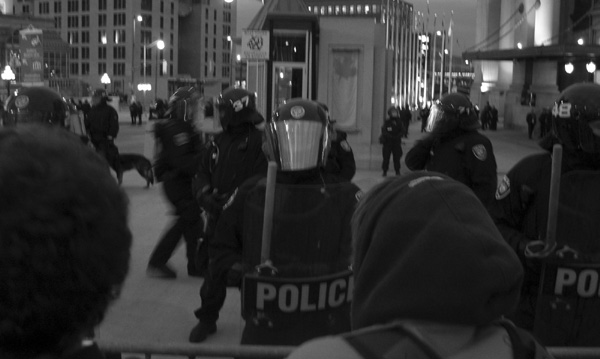
Many critical criminologists, sociologists and legal scholars have spoken out against our late modern preoccupation with the criminalization of social problems. I’m a particular fan of Richard Ericson’s comments on the issue in ‘Crime in an Insecure World’. One of the most problematic – and unfortunately, most popular - ways to criminalize a social problem is to locate it within a ‘war on’ framework. The current, paramilitarized state of policing owes much to the influence of the ‘war on drugs’, ‘war on crime’, and lately, the ‘war on terror’ (note that Mr. Mammoliti, according to the CTV article, seems to equate gang crime with terrorism). Without going into too much detail, it’s important to note that the ‘war on’ framework has never produced solutions to the problems it is applied to. The ‘war on drugs’ is perhaps the best example of this – prohibition is a proven failure: it fails to reduce use and addiction levels; leaves underlying public health concerns unaddressed; increases prison populations (and through this, the subsequent disintegration of families and communities); creates a lucrative black market in narcotics that guarantees the ongoing involvement of organized crime; and, thanks to an escalating and profitable arms race, it has led to the gradual paramilitarization of policing.

The so-called ‘war on terror’ offers additional examples of the inevitable results of declaring war on a noun – the underlying problem remains unresolved, but everyone winds up with more guns. In the contemporary context, and under the ‘war on terror’ rubric, we are seeing the continued blurring of boundaries between policing and soldiering, with detrimental consequences for the rule of law and fabric of democracy.

I mention this in order to put Mr. Mammoliti’s comments in context. His ward is dealing with a serious set of problems related to firearms and gangs (and poverty …), and I am sure that he is sincere in his expression of frustration, and in his search for alternative solutions. In his frustration, he is proposing a proto-fascist response that closes the policing-soldiering gap and re-frames the problem within a warfare / enemy logic (as opposed to a crime / criminal logic). This is the product of gazing at social problems through a ‘war on’ lens.

Mr. Mammoliti’s proposal will not result in ‘boots on the ground’ in the north ward. Such an action remains politically impossible (for now), not to mention a violation of some of the basic principles of liberal democracy. One cannot simply deploy the military for policing purposes, even within the new Canada Command framework. Realistically, we can anticipate some political claims-making both in favour and in opposition to the idea, probably resulting in calls for increased policing resources.

The Chief of the Toronto Police Service issued a response to Mr. Mammoliti's statements this afternoon, condemning them as an insult to the work of the police. I had hoped that the Chief would have made some additional remarks on the fundamental differences between the Toronto Police Service's mandate and that of the Canadian Forces. Oh well!

What is interesting about this case is the way Mr. Mammoliti’s comments offer us a glimpse at the sort of authoritarian (I would say ‘escalationist’) impulses that often lurk beneath mainstream discourses of social control. What fundamental ideas about the nature of social problems, law, policing, and justice underlie a “send in the army” argument? What can we say about a society where the essential differences between policing and soldiering seem inconsequential?